Varanasi, Uttar Pradesh - story board n.8 travel in India
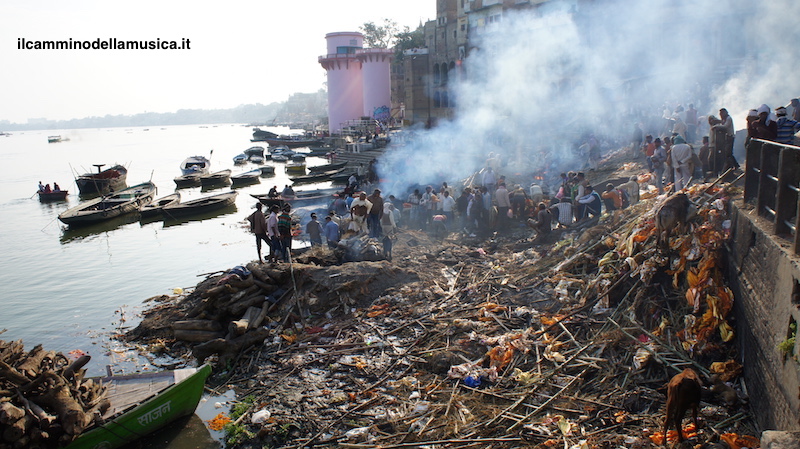
When I arrived in Varanasi I did not understand the importance of this river. Now, after some days, I can perceive clearly its power. The Ganges or Divine Mother, as they call the river here in Varanasi, is the hub of this magical city. It seems that the city lives in function of the river, which embodies the life and death of the Indians people. The activity at the edge of the Ganges is intense and uninterrupted. Its waters are thousands of years the safe of all the prayers and all the mantras of the Indians and their deaths. Can you imagine that power? ITALIAN VERSION
For some people it is hard to believe, but water has a memory! The japanese scientistMasaru Emoto, recently died, discovered it: He has shown that water crystals take different forms according to information they receive. So, the reaction to the word "I Love You" is a crystal form homogeneous, perfect, like a mandala, while the word "I hate" is a crystal amorphous, irregular and without any grace. (o learn more, I recommend watching this movie). Now, taking this knowledge, it is easy to see that, we are made for the majority of water, so we can modify our cells simply informing them the right way, through positive words, healthy places, healthy activities, good companies and good music! More we can stimulate the cells of those who are close to us through compassion, affection, generosity and other virtues.
So I and Federico did not hesitate to bath on this sacred river. Some residents of Varanasi do it every day, other Indians travel miles to bath at least once in their lives, and many people drink its water! Ganges is one of the most polluted rivers in the world. But the light, you know, always wins versus darkness.
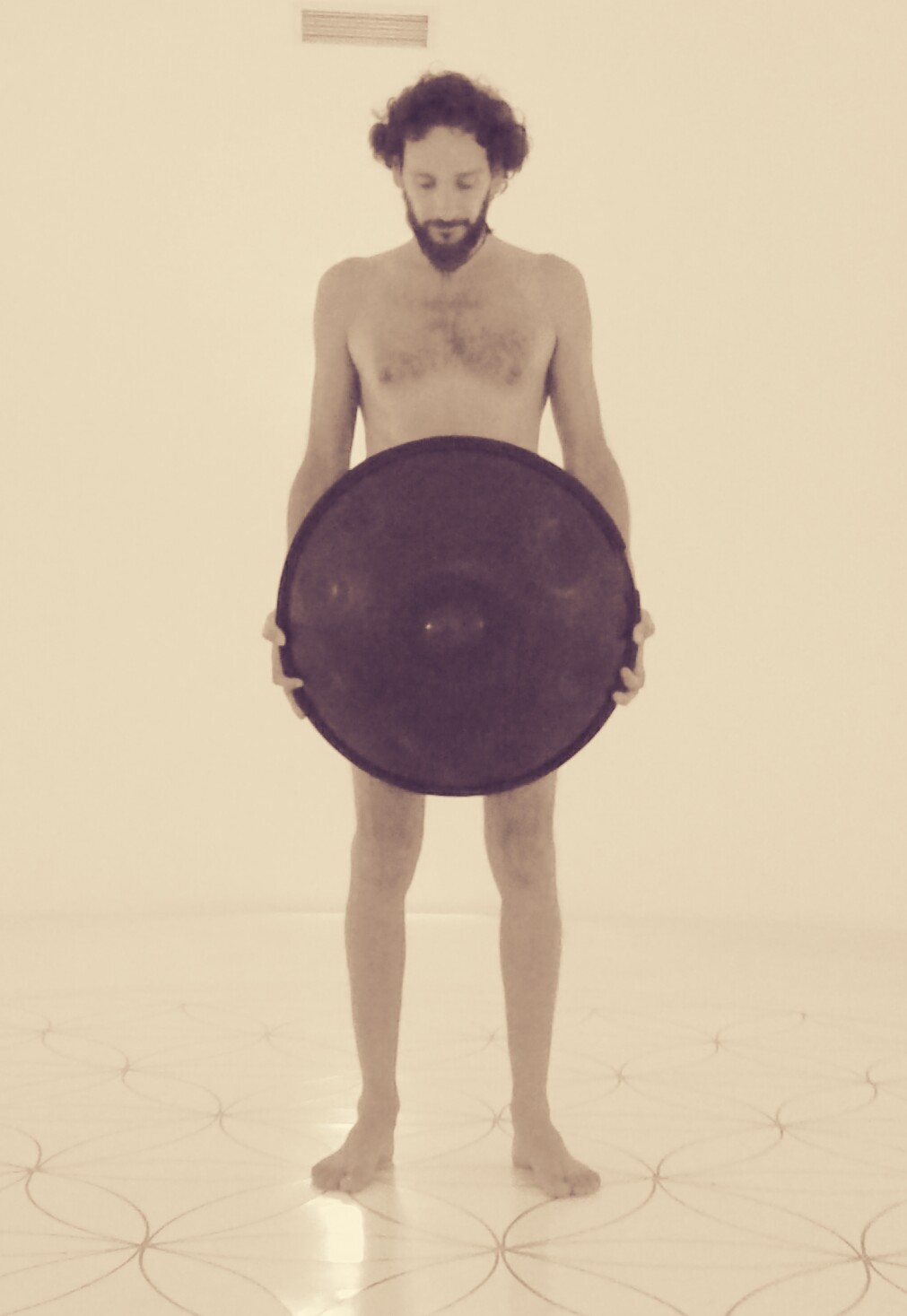
And so I leave this city, dipping my body in this magic river and informing its crystals with my intentions and with the sound of my Hang Drum. Thanks Ganges, thanks India.
A sailor, a musician, a music searcher: melting the cultures of 4 nations during a journey by sailboat
A musician more aboard at each stop:
the creation of a multi-cultural crew
One mission:
composing the integration’s soundtrack
AND ONCE BACK HOME WE'LL TELL YOU ABOUT OUR JORNEY THROUGH A MULTI-MEDIA SHOW
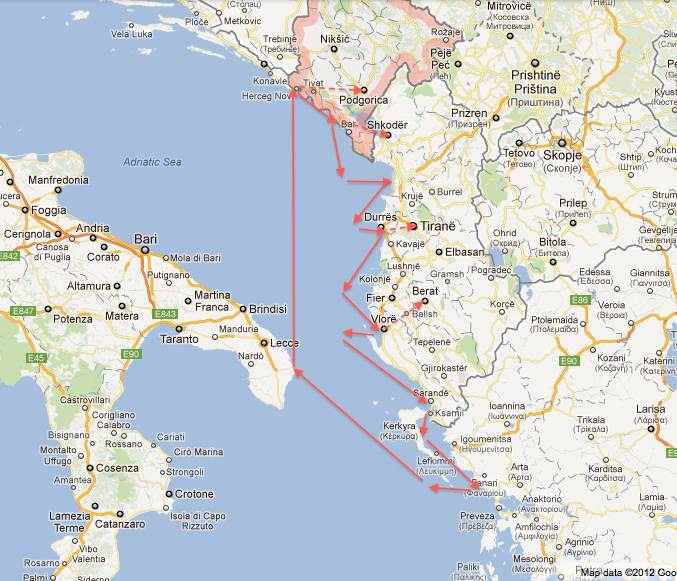
The route: Italy, Montenegro, Albania, Greece
ACTIVITIES:
documenting the traditions of every Country we’ll pass by
telling Italian emigrants’ stories
.
overcoming cultural divisions andenhancing the rerritoy
.
THE INVESTIGATION: Diego and I will leave the next summer (2012) to investigate on the places we’ve chosen. Our aim is to look for the musicians (a Montenegrin, an Albanian and a Greek) who will come with us on the sailboat in 2013, for the real "One song 4 people".
YOU CAN SAIL WITH US TO LIVE THIS PROJECT ON THIS SUMMER (2012)! write here to know the offer: dondiego79@tiscali.it
JOURNEY FINANCING:to finance this journey we’ll use some crowdfunding website. Using this system, anyone who likes our idea will be able to finance it with a little sum of money: he will be given some prices, according to the sum he decides to give. All of the prices have the function of sharing the events and the spirits.
Chula, Samba de roda, Samba carioca:three music genres that are very similar and put together the taste and the character of the whole Brazil. A music that everybody in the world likes, knows and envies, it express itself through the energy of the syncopate rhythm, the saudade of the song and the sensuality of the dance. A music that has its roots in the black Africa and grows its character in the Brazilian territory with the slaves’ songs. .
Walking through the stalls of Santo Amaro da Purificação, I’m going to discover with Roberto Mendes the origins of the Samba in a country that has been able to transform the poverty in a strongbox of cultural and musical richness. Roberto says: “Santo Amaro da Purificação is a family,I think that it’s the only place where the poverty has been generous... because we have wonderful songs and a delicious food. Who can prepare a good dish with pork ears, skin and feet if not the necessity to do it? Only the necessity can create a good kitchen like the Reconcavo bahiano one. In this way the fajoulada bahiana was born, invented by the slaves that mixed the things that white people didn’t use. The food determines people’s culture and their sound is the Chula”. VERSIONE IN ITALIANO - VERSIÓN EN ESPAÑOL .
HISTORICAL SOURCES: The Chula is considered the antecedent of the traditional Samba like all the Brazilian genres, it’s the result of a syncretism of different musical cultures. In the XVI century the Portuguese began to deport to the so called Reconcavo Bahiano Region – that includes only few towns of the Bahia State, among those there’s Santo Amaro de Purificação – the first Angola slaves, the promoters the Bantu culture. In the XVIII century was the turn of the Sudanese slaves of the Beni culture. The mix between these two African cultures, with the Portuguese and in part with the aboriginal ones, gave origin to the Portuguese Chula Aldea, that is a labour song used in the sugar cane fields and during the parties that the slaves had after many forced labour hours. A musical richness generated by the poverty and the labour of a population that had sound and rhythm in their blood and was able to translate every labour movement in a rhythm, every moan in a song. Some sources say that the Chula later generates the Samba Carioca thanks to the migration of the bahian blacks to Rio de Janeiro in the XIX century
THE CHULA:according to Roberto Mendes the Chula is a “behaviour translated into a song”.The words are about love, nature, the rhythm is snappy and syncopated, the dancing is lively and sensual, but at the same time it's elegant. One day I asked to Roberto how can words, rhythm and dance of this genre be so cheerful, if they are the result of many trials, injustices and a miserable life lost working for the colonizer owner. Roberto answered me in a simply way, as it was the most obvious thing of the world: “African People never renounce to the cheerfulness and they live the sadness in a different way compared to other people. The Chula is generated by the necessity to sing in order to maintain this cheerfulness”.
DURING THE PARTIES THE SLAVES SANG songs in honour of the women who created, with the instrumentalists, a circle, and inside of it they danced at the Samba rhythm. That's why they give it the name “Samba de Roda” that literally means “Samba in circle”. Roberto tells me that years ago only the women used to dance the Chula and, according to the tradition, they can dance only when you play, while when you sing, they accompany the song with the claps of their hands. Today it seems that these details are not longer taken into account, so the Chula and the Samba de Roda are often associated to the same dance.
THE FOLLOWING MP3 IS A CHULA DO RECôNCAVO written by Roberto Mendes and played with the group "Roberto Mendes & Coisa de Pele": Roberto Mendes (violão), Arinaldo Nascimento (Rebolo), Sinho do Cavaco (cavaquinho), Dagmar Ferreira (repinique), Didhe Prado (pandeiro). The title is Linda Morena. Roberto Mendes is considered one of the most estimated Brazilian composer and guitarist of the last twenty years. He's a great expert of the musical tradition of his home country. Roberto is the only Brazilian guitarist who uses a particular and difficult technique to play the Chulado Reconcavo and the Samba de Roda. He wrote pieces and collaborated with very famous artists like Gal Costa, Caetano Veloso, Paulinho Boca. He travels always into America and Europe, but he always can't wait to come back to his beautiful and simply Santo Amaro da Purificação.
THE DREAM: the unpronounceable title of this article is the name of the first native community that I’ve the good fortune to visit in Brazil. This experience fulfills a dream that has been only a secret wish since a long time: to record in loco the music of a native tribe. In Paraguay I was close to do to it, but a series of unlucky coincidences forbade me to visit an Ayorea community; then I arrive in Santo Ãngelo in Brazil and, without expecting it, here is a great opportunity to me handed on a silver platter: ClaudetteBoff teaches history of art at the University of Santo Angelo and has been working for long time with a Guaranì community and she is an expert of this culture. "BOFF, Claudette. "A IMAGINÁRIA GUARANI: O ACERVO DO MUSEU DAS MISSÕES", Santo Ângelo (RS)-Brasil: Centro de Cultura Missioneira -CCM/URI, 2005" is the book she wrote about it. VERSIONE IN ITALIANO
THE ACCEPTANCE: have access to this community isn’t so easy, you must “have friends" who have connections with those people. The natives still set in communities far from the town, they seems – in my opinion for some obvious reasons – to mistrust of the white man, or better, a representative of a modern society and a culture that in the past has imposed in a violent way, obliging them to a forced conversion. It seems that the religious conversion process still continues nowadays: the native I would have gone with to visit the Avorea community in Paraguay, has told me that in his village work two North American missionaries who have the task of converting – with quite childish methods – the ayoree belief to the Catholicism. But I don’t want to waste too much time on this theme, because I haven’t had the opportunity to verify if these missionaries are really there. I will tell you only my brief experience in this Guarani community, hoping it wont be the last one, in fact I had the opportunity to experiment only the more superficial part of this so enchanting culture, the native mother of the most music I inserted in this blog until now. So, I will tell only the impressions of an occasional visitor.
I’ve known that many ethno-musicologistsand and anthropologists have been studying for many years in loco the traditions of those people, but they have never had the permission to take part in their religious rituals. So I count myself lucky to have attended one of their musical demonstrations organized only for me.
THE COMMUNITY: is located at the municipal building of São Miguel at about 50 km far fromSanto Ãngelo. Once arrived in the center of the small village, you must enter for 40 km inside the Brazilian forest. Thanks to Claudette I get from Santo Ãngelo University a car and a companion, in exchange for a brief musical performance. The offer seems to me very convenient so I accept without reserve.
STRANGE ANECDOTES: during the travel, Luis Octavio, the historian that accompanies me for the occasion, tells me some curious anecdotes sometimes quite sinister about the habits of this community. The belief that impressed me most is this, n case of a twin-birth, one newborn must be sacrificed, and in particular the one who represents the wicked part of the spirit that has divided between the two newborn... nowadays the sacrifice is not longer practiced, but the unlucky baby must be left to someone else’s care.
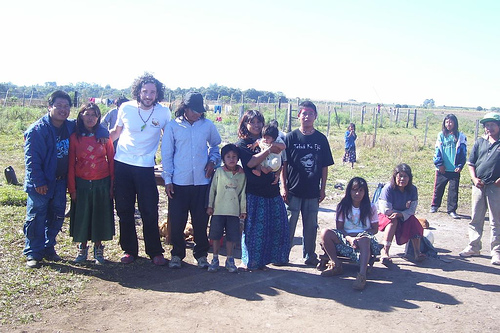
THE MEETING: Claudette has prepared some bags with warm clothes and a box with some meat to give to the community to thank them to have accepted me. After many kilometers on a dirt road, we arrive in the small village of the natives in the middle of the Brazilian nature. The landscape is evocative. The children seem to be scared by the car and they run inside the hovels build up with straw and mud. The instruments are still ready, piled on a Bongo. We get off the car and greet: the children come out shyly from the refuge and they show their very white smiles on their dark sweet and dirty faces. Floriano arrives, he’s the Cacique (chief) of the village, or better, the ex cacique. Now the “throne” has passed to Nicanor. Unfortunately Claudette, Floriano’s friend, didn’t know this change and this detail has provoked a series of misunderstandings during the visit that obliged me to leave the community untimely. The impression that Luis and I have had, was that the new chief – who didn’t feel considered like this – decided to cut short and let we go away.
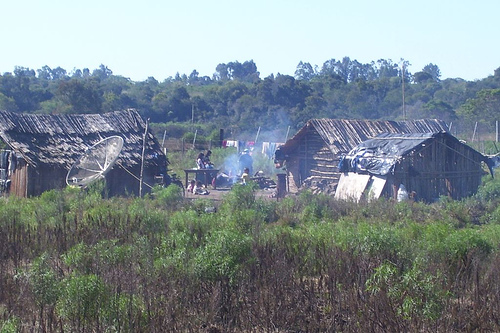
. THE VILLAGE: is composed really by few things. Here live more than two hundred people, with agglomerates of scattered hovels on a wide zone. Next to a house, a fire lighted with five crossed trunks is ardently waiting the meat that we have brought with us. The houses have neither the bathroom nor the water, so you must walk a few to find a well. I couldn’t enter in a house, but from a door I’ve discerned the inside, poor, with mattresses on the floor and thousands of amulets and handcrafts hung on the ceiling. Among all this “poverty” there’s a detail quite controversial: behind one house there’s a big satellite aerial... an authentic paradoxical view that breaks the charming aspect of this village, morover, some inhabitants have mobile phones. Floriano calls the group and tell them to tune up the instruments. Immediately all the children of the community come there and line up in front of me – I'm preparing excited the recording instruments.
THE MUSIC: the melody is always the same, only the texts change. The children move some dance steps that make me smile. I try to imitate them, joining together to their movements, but negligently I imitate the steps of the female dance, so everybody looks embarrassed at me and laughs. For every piece, Floriano explains me the meaning of the words and the music, and he calls a boy – who can read and write – to write them on my pocket book. Even if he is not longer the cacique, everyone respects him and does what he tells them to do. When I ask something to someone, they must wait for the allowance of the cacique to give the answer. Among them they communicate in Guarani...
FREEDOM: after the performance, I begin to become more familiar with the inhabitants of the village and the children latch on to me touching me everywhere and running away laughing when I try to communicate with them. I cannot make out the age of many women. They have a very particular body physiognomy: some mums are feeding, one of them seems to be about 15 years old. Everybody is very curious about my presence, they give me big smiles when our eyes cross, except a vague-color eyes woman, with an expression of deep sadness that impressed me a lot. This community lives on the cattle they rear in the surrounding huge prairies and on the crafts they produce with natural materials, birds feathers, seeds, etc. and then sold in the nearby towns markets. Some of them are real works of art. I walk around with Floriano who shows me the school, the doctor's office, the pigsty, the animals he rears, etc. He explains me that this community comes from Argentina and is semi-nomadic. In some year periods they leave the village and come back to Argentina or Paraguay, where they have other relatives. It’s for this reason that Floriano can speak Portuguese and Spanish so I can easily communicate with him. Floriano is a very nice person, he’s generous and open-minded. He tells me he would like to take his musical group to Italy, and he would have a microphone like the one I’ve got. He thanks me for visiting them because it's important for him that other people gain knowledge of his culture. Once reached a good level of familiarity, I ask him if he would ever live in town. He answers me like this: "No, I want to be free" than he tells me here he has all the necessary to live, his animals, his home, his land, his community, and he’s happy.
The following piece is entitled "Kyringue i Joguerojae". It’s a song of the Guarani Tokoa Koenju community. The instruments used are: guitar, violin, bongo, maracas. The guitar and the violin are two European instruments, acquired by the Guarani culture during the period of the Jesuit evangelization. The Guarani culture wants the guitar to have 5 strings instead of 6, and the violin 3 instead of 4. Moreover, the tuning of the instruments is very different from the traditional one. The guitar uses an open tuning, in this way, without using the left hand, it gives a chord of minor tonality and then it will be sufficient to get it major putting a finger on the first string on the first fret. The most used tuning is the: A, E, A2, E2, C, but a specific diapason doesn’t exist. The violin imitates the voice first and the stanzas then and it accompanies with two strings tuned on a third-interval. The rhythm is binary. This kind of song is used in some religious rituals. The dance is very easy and uses only the legs and feet movement. The male movements are different from the female ones. It isn’t a dance to be done in pairs.
THE TEXT: Kyringue i joguerojae o yvy porã ka aguypora ndoguerekovei ore rovy a iaguã ore rovy a iaguã
Children cry together and are sad about the good land they no longer own, our happiness, our happiness...
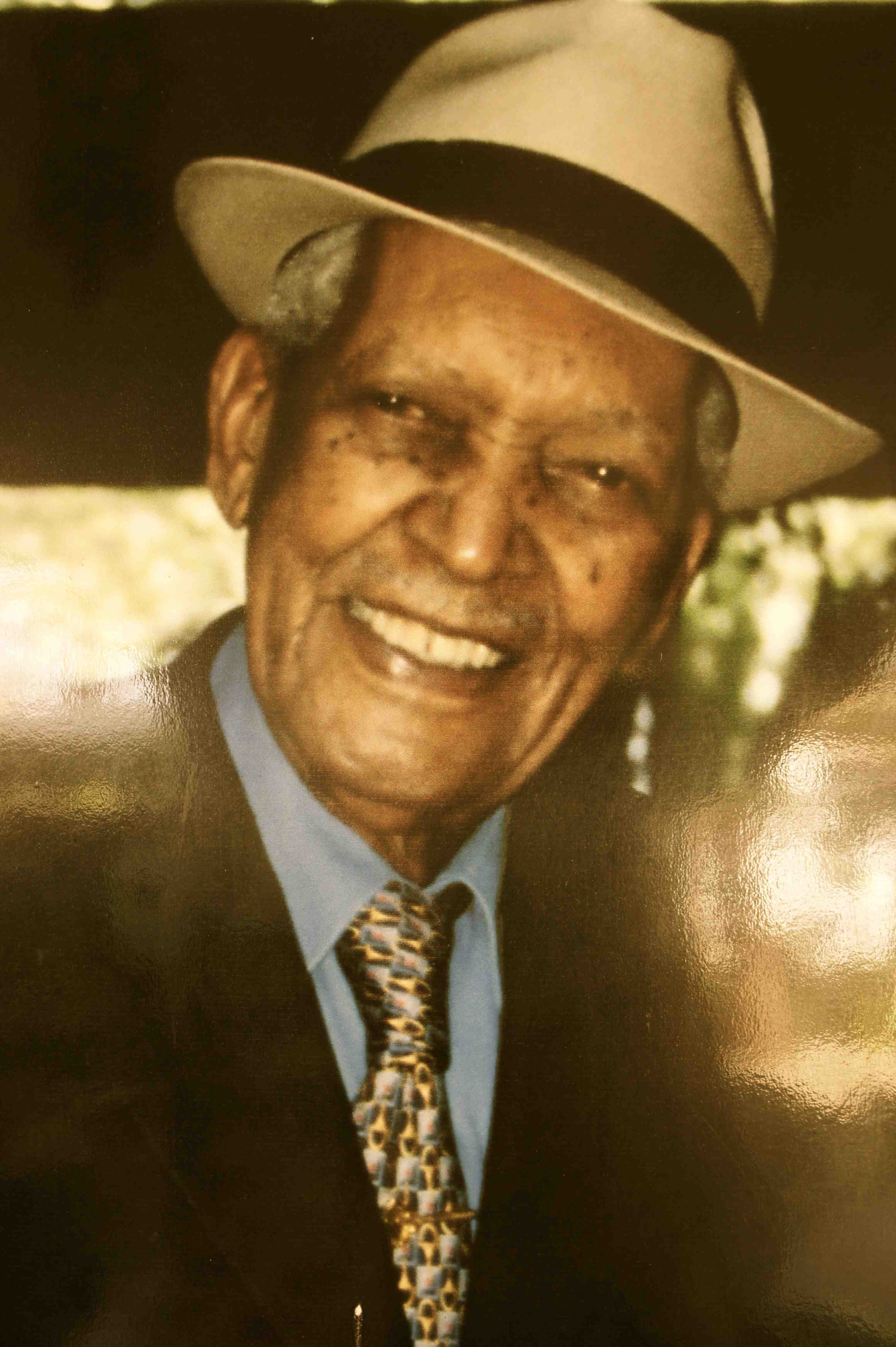
IN A TRIP TO CUBA whatever the reason for the trip, it's inevitable not to remember one of the most known Cuban musicians in the world, whose fame is related to a film that made an entire generation dream. The film is entitled Buena Vista Social Club (Wim Wenders 1999) and the main protagonist was Maximo Francisco Repilado Muņoz, known as Compay Segundo, the Cuban old man with a cigar in his mouth and music in his blood, who became,with his group, one of the icons of Cuban music thanks to this film. VERSIÓN EN ESPAÑOL - VERSIONE IN ITALIANO
THE IMMORTALITY OF A MYTH: his death in 2003 made his image and some of his songs, like "Chan Chan" and "Las flores de la vida", immortal.
Today it is the "Grupo compay Segundo" whose leader is Salvador Repilado, Compay Segundo's youngest son that continues his music and fame...
BACKGROUND: I got to know them in Italy when I was working for the group who was on an Italian tour. At the time the project was managed by my guitar teacher Massimo Scattolin, who together with other musicians and the collaboration of various Italian Symphonic orchestras, compiled/realized the cd "100 aņos Compay" (Indiewizard 2008).
THE "OLD" BUENA VISTA: some of the musicians come from the old group, like the clarinetist RAFAEL INCIARTE; I met him in the barrio where he lives, in Cohimar, in the south of La Habana, and thanks to him I could live unforgettable moments with the "Trio Heming". As well as Rafael Inciarte, also Haskell Harmentero at the clarinet, Hugo Garzòn as main singer/t the first voice, Rafael Fournier at the percussions, are part of the "old" group. I met Salvador Repilado in his luxury villa in a beautiful barrio in La Habana.
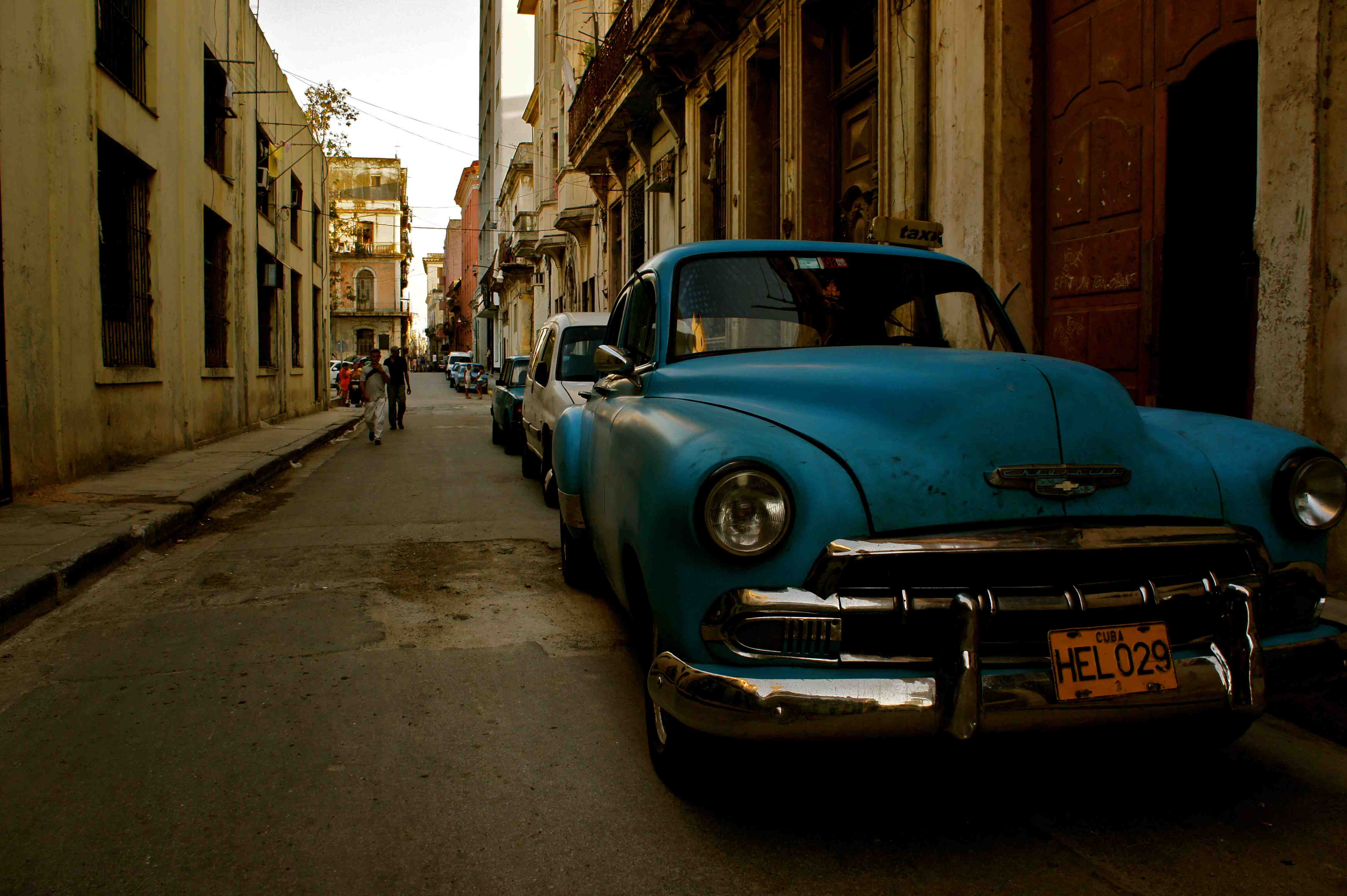
THE CUBAN DREAM: it has been a strong emotion to meet my Cuban friends in their home, in their magic Cuba. It's here that you can understand why this music attracts thousands of amateurs and music lovers. Here, where the atmosphere is immune to the erosion of time. Recently I saw the film "Wim Wenders" again and I found in it the same Cuba I found in my trip. The light, the means of transportation, the atmospheres, the colors and the ideas are unchanged and unique ingredients.Magic and at the same time paradox of this beautiful country..
THANKS: Salvador Repilado, Grupo Compay Segundo, all the staff of "Casa Compay Segundo, Massimo Scattolin( Indiewizard).
"Don Don open to Sant'Andoine, Don Don open to Sant'Andoine!"After repeated in almost 15 different houses for three days, you wont be able to remove it from you're head for almost a month!
17 January; I am inPenna Sant’Andrea (TE)"the most important village of the province in the world" like Augusto always say, virtuous blasphemer of the saint, that all year long waits with impatience this date, releasing the tension on the costumers of his bar, in the little plaza of the village. His bar is most certainly the worst bar of the province of the world. If you go there and survive, you wont be able to stay with out it. It's already the fifth time in this trip that I turn up there, and without exception I get out with my soul damned and my liver pulped. Today instead Augusto's bar becomes the place of departure of the Sandandonaijre, the group that I will follow during the ritual of the begging that characterize the feast of Sant'Antonio Abate. VERSIONE IN ITALIANO
We leave at an imprecise our with a number imprecise of musicians; the cert thing is the humid cold weather. Augusto chooses a way, Roberto rubs his hands before putting some broken gloves, then warms up the little organ by playing some notes e then we go in the quarters beneficing houses, families and domestic animals, singing about Sant’ Antonio fighting against the devil.
Bonasera bbona ggende, che vivete allegramende; ve salute Sand’Andonie, prutettore condr’a lu Demonie. (Good evening good people, that you live happily; Sant’ Antonio, that protects you from the Devil, salutes). It’s with these verses that they are welcomed in the houses; people are waiting for them; they know that if it wasn’t yesterday or the day before, today will be their turn. Some of them made a chicken fat up so they could give it to group; it’s the maximum gesture of grace for the group that brings the benediction of Sant’Antonio and the happiness of this festivity. Some cook succulent banquets to offer to the group. “Lu cellitte” are the traditional delicacies with the shape of birds. Three or four songs are dedicated to each family, then the group fills of gifts the basket, leaves singing the “don don” e walks (always more staggering) towards the next house.
press "cc" for subtitles
The Sant’ Antonio is a ritual of prayer that has a lot of importance in the pagan tradition; it takes place in the period of agricultural break, when the arms can rest waiting for the spring. It’s a ritual of good luck for the harvest, for the health of the domestic animals and of the family. It’s more importantly a way to stay all together: in a little community the ritual restores and strengthens the human relationships, because it is based on a religious-playful aspect, on the exchange, on the joke, on the chat, on the demonstrations of careness and affection.
The pagan and religious aspect blend making more human the soprannatural and at the same time more soprannatural the human. Gianfraco wares a vest and performs Sant’ Antonio. He tells me the legend, transmitted by Atanasio, of this Saint born in Egipt proponent of a life of strict asceticism. He's always represented with a little pig at his side. The Antonians infact cured with the pigs lard the “Sant’ Antonian fire”. The period of the calendar where is placed the saint's feast day coincides with other peasant rituals like the pig slaughter, the fires in the winter Solstice and so Sant’ Antonio is the protector of the domestic animals and of some diseases. It’s still usual custom to put an image of the Saint in the barn.
This ritual, that was in danger of exctinction, today is reinvingorated; it’s not rare to see other groups of kids in the streets with “ddu bbotte”(little organ) and a “battafoche”(friction drum); it’s an indication of revitalization of tradition filled with modern social codes, maybe because of the need to find an identity.
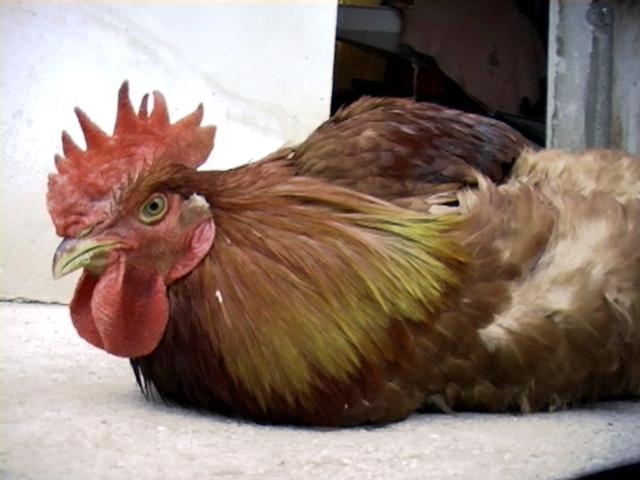
When the “Sandandonaijre” finish their tour is almost night. Even this year they have accomplished their mission. Augusto’s car is fill of roosters. The group will eat them in some months (I ate the ones of last year). Our livers ask pity but our heart is light and waits for the next Sant' Antonio.
In the mein time the worst bar of province of the world will remain, like the heart of who manages it and goes there, always open.
Thanks: to all of the sacried roosters, to Lj Sandandonaijre, to Antonio’s bar and mostly at his “vocalucci”, to Tonino Fabri, mayor of Penna, to Gianfranco Spitilli (http://bambun.webnode.com) and his cowbell, to Antonio and his family and theyr restaurant Zà Beata, that hosted us and made us put on weight in our worst moments.
I’m in Garanhuns, a small town in the state of Pernambuco (Brazilian nordeste). I’ve decided to change my route and leave in this way the coast so rich in music but – alas! – also in tourism that in part impedes my researches, in order to enter the heart of Pernambuco that seems to be the heart of Brazilian music. It’s here, in fact, that the musical genres that most represent the Country are deeply rooted. VERSIONE IN ITALIANO .
THE COINCIDENCE: Elaine is a São Paolo great photographer who shares with me this journey inside Brazil, We known by coincidence on the combos which was taking us to the wonderful Itamaracá Island where I had to meet Lia de Itamaracá, an important singer of Ciranda (a Pernambuco popular genre). Elaine is carrying out a project very similar to mine: she goes alone across Brazil photographing music. It’s incredible how development, dynamics, problems, contacts, experience of the project fit together with mine. But she started her travel from the north of Brazil in order to come down, I do the contrary. We met in Olinda (see the post: Olinda che linda) and so we decided to join our forces and walk along together for a while, then everyone will go on theirs own way.
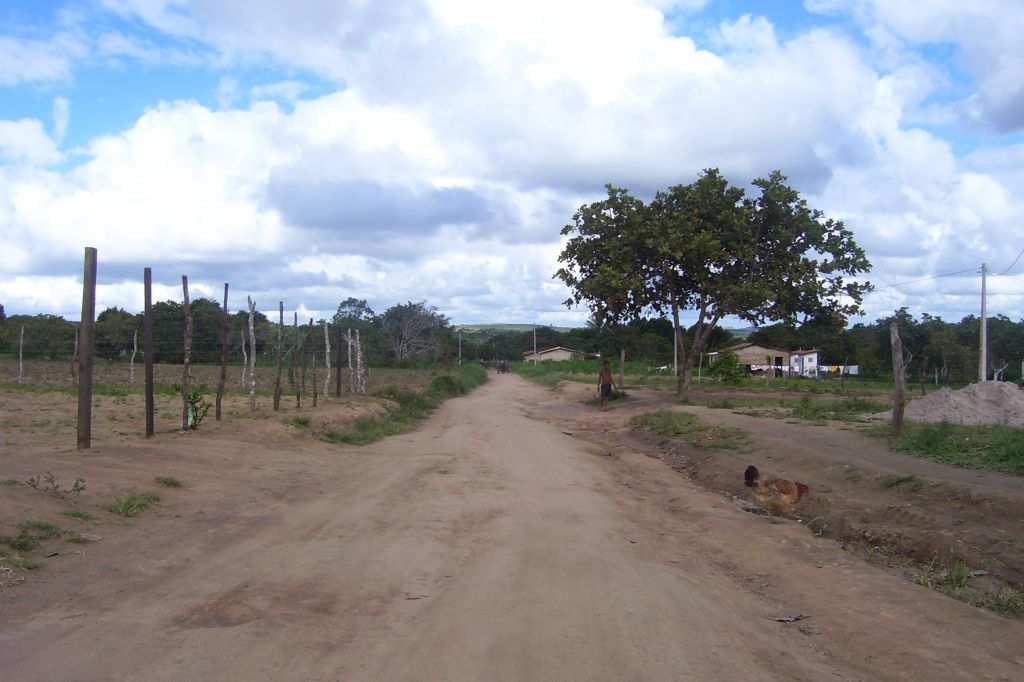
MUSIC RICHNESS: Pernambuco offers an enormous quantity of music and musical genres. The amount of material, joined with the travel problems like the sudden displacements that often occupy many time for reaching the hardest zones, the unfavorable weather conditions (we’ve been staying in Garanhuns for two day due to the rain) don't enable the fast and steady blog updating. The quantity of things to be written and documented is – fortunately – enormou. In this state I had the good fortune to know the Ciranda of Lia de Itamaracá, who has been declared living heritage of the culture from the UNESCO, Ana Lucia’s Samba de Coco and then forró, Frevo, Maracatú, Capoeira and so on; then after two days traveling by bus, car, motorbike and...by foot, Elaine and I - through the suggestive landscapes of the interior – reached a native community called Fulniô. A native who lives in Olinda gave us the contact to visit the aldeia (village). .
THE TRIBE AND THE SACRED RITUAL: the community lives in an aldeia near Aguas Belas a town 300 km far from the coast of Pernambuco. It’s known as the only community of the Brazilian nordeste which preserves the oldIa-ténative language. The aldeia is divided into two parts and one of these is in the middle of the forest, but we - and in general the white man - cannot enter. This is, in fact, the site where in September and October people celebrate an ancient and sacred ritual called Ouricuri. Nowadays nobody knows what it is exactly because the religion of this culture forbid to tell and reveal the secrets of the ritual. The belief says that who tell something to someone will die by a strange death...
Who is now telling us this is Vera, a native who has welcomed us and accompanied – without losing sight of us – during our whole adventure in the aldeia. Vera is a native with very particular features, she tells us to be a not-at-all-native, but to have some white and black race features. Her dark blue eyes are very beautiful. Her name in in Ia-té is Tafireskane. This is the name the Quesique of the tribe gave her when she was born. The other aldeia, that on the contrary allows the access to everyone, is very close to the town of Aguas Belas. It’s a group of cement hovels not so cared and disposed with no order. Here the architecture is very different from the Tekoa Kõ e nju aldeia that I visited in the south of Brazil (see the post: Tekoa Kõ e nju). This part of the aldeia is also a FUNAI (fondação nacional do indio) seat. Fulniô people are integrated with the population they call "civilizada" o “branca” (these two terms indicate all the non-native people). Many of them work in the public sector as for the police, the municipalities, in FUNAI bureaux, etc. But during the Ouricuri period they have the permission to leave their job in order to devote completely to the ritual. .
THE RITUAL FOR ME: Vera has prepared for us a dance and music show. She says that what we will see aren’t the songs and dances of the mysterious ritual, but only a demonstration of how they are committed to preserve and let know their own culture. The group join up; it’s composed by six men and three women and a series of children who are looking at us a little bit scared. We all get on a wrecked bus with our instruments and costumes in order to reach the borders of the forbidden territory. During the journey on dirt and full of holes roads, Elaine and I – in the group we seem two white spots – try to have a dialog with our companions who unexpectedly reveal themselves very nice and friendly. Children look at me furtively and when I cross their eyes they turn their head and – blushed – they guffaw. The sense of “extraneousness” that I perceive is so deep. On the bus they have a big wood pipe and adults and children in turn breathe in black tobacco. When it's my turn I take a puff but accidentally some smoke goes me down. Classic movie scene: I – totally purple – cough and the natives are now laughing at me. It wasn’t tobacco, it was fire powder. .
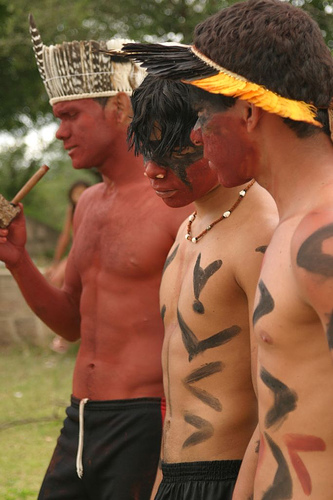
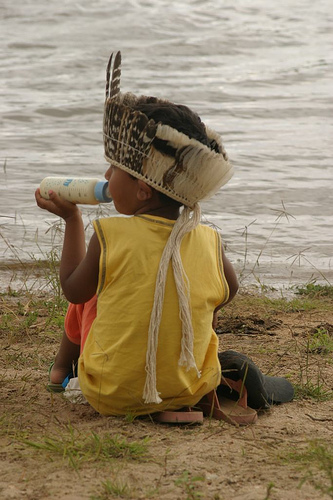
THE DANCE PREPARATION: we arrive near a very beautiful lake. The landscape and the quiet are really evocative, but the big electric cables plough the background and ruin that great shot. Everyone goes in the lake to purify, then the preparation for the show begins. In order to paint their bodies they use colors made by resins and typical fruits of this area, for the black they use the coal. They prepare all instantly. They use warrior costumes and symbols that are typical of this community. Elaine enjoys the time with her camera, I try to record all the possible. Then I walk around for a while with Vera who explains me some details of “public domain” about the ritual: there are some areas of the aldeia where women cannot enter, then during the whole period of the ritual it’s forbidden to practice sex, drink alcohol, listen to music. The ritual needs also to elect the authorities who represent the community which must stay isolated for three months. I cannot know nothing about the modalities and phases of the ritual. The group is ready to dance.
MYSTERIES: choreographically, the show is no doubts suggestive, but I'm quite unsatisfied because each attempt to investigate the meaning of words and movements of the dance has been put aside with vague explanations and in my opinion previously prepared. It’s an homage to God to ask him to preserve our land and our culture”, “It’s a song to thank you for your presence here” says Vera. After the performance I walk for a while with the quesique who shows me the different plants of the aldeia and their therapeutic functions. He says he can treat every indisposition without using chemical or pharmaceutical cures. The dancers go again into the lake to clean their bodies from the dye and then we come back all together to the aldeia. Many natives go away to work, I remain there with Eleine, Vera and some inhabitants in a small house with a table and a sofa. I – stubborn – continue to make more specific questions about music and culture, but I continue to take out few information. I ask to explain me at least what’s about the song I’ve recorded. Among them they speak in Ia-té, and I’ve the impression that before giving me any explanation they consult together. Also in the aldeia in the south of Brazil happened the same thing: in this occasion they communicated in Guarani and before answering me they waited for the Quesique’s allowance.
LEFT WITH A BITTER TASTE: The adventure has been undoubtedly interesting, but once again I came back home with a bitter taste in my mouth and a strong feeling that I haven't had even a little contact with a culture that I really desire to know more in detail and from that I really can learn something. Anyway, in these days I'm in touch with a girl from Manaus who is waiting for me. She explains me that even experts and researchers who have been in contact with native Amazon communities for many years didn't have the opportunity to go over the knowledge "boundaries". It’s something that I can understand, considering the cruel submission in the past times imposed by the white man, who, in reality, in this land he would be the intruder. But my curiosity still remains unsatisfied and so still very deep.
The following is a song (cafurna) that the Fulniô group offered me during the performance I’ve described above. The instruments are few because the music is based completely on the voice. They used maracas and caxixi, nothing else. There’s only one person of the group who sings verses and then the rest of the group answers him in unison. It’s him who direct the dance. So the modality of the song works like in the Samba de coco (I hope to find the time to talk about it); talking with Vera I discover that some rituals include this genre which actually has also native origins, as a result of the meeting between the slaves escaped from the inside and the natives. Unfortunately I cannot publish the text and the translation of its words, despite my fond attempts to know them. According to what they explained me, the song talks about the aldeia: in the past it was built up with straw, then the white man set fire to the village and the community move along the whole region until the day they joined to create this new community. I know that this group has already performed in public and they also recorded something, but I cannot find this piece in the archive. I’m in touch with an expert of the Ia-tè language, let’s see if he can help me. In the meantime, enjoy this audio clip.
THANKS TO: Fulniô Community, Beto Hees (Lia de Itamaracá’s producer), Lia Menezes (for all Pernambuco contacts), Olinda Capoeira school (for the performance they offered to me), Ana Lucia (a samba de coco singer from the area of Amaro Branco in Olinda), Eleine Santana (www.elainesantana.com.br), she took these photos of the native community.
I arrive to Bento Gonçalves at night. It rains. The contact I have doesn't answer the telephone. What can I do? I go to a Hotel and I ask for a room. All booked, except a sort of rat-hole in the basement. I take it. I remember that in Santo Ãngelo, I called the radio of Bento Gonçalves and, fortunately, a certain Isidoro, a parish priest of the diocese of Santo Antonio, answered me, and with him I had some talk in the Veneto Dialect. I ask the hall porter if he know him. He answers me that in the country everyone knows Padre Isidoro and he tells me where I can find him. I go to his place. Padre Isidoro is a person with this kind of energy, vitality and enthusiasm that in the following days the idea of becoming a priest entered my mind time after time. The day after, thanks to him, I'm a guest in the best hotel, situated in the center of the country, and I have a list of people to meat and many things to do. VERSIONE IN ITALIANO - VERSIÓN EN ESPAÑOL
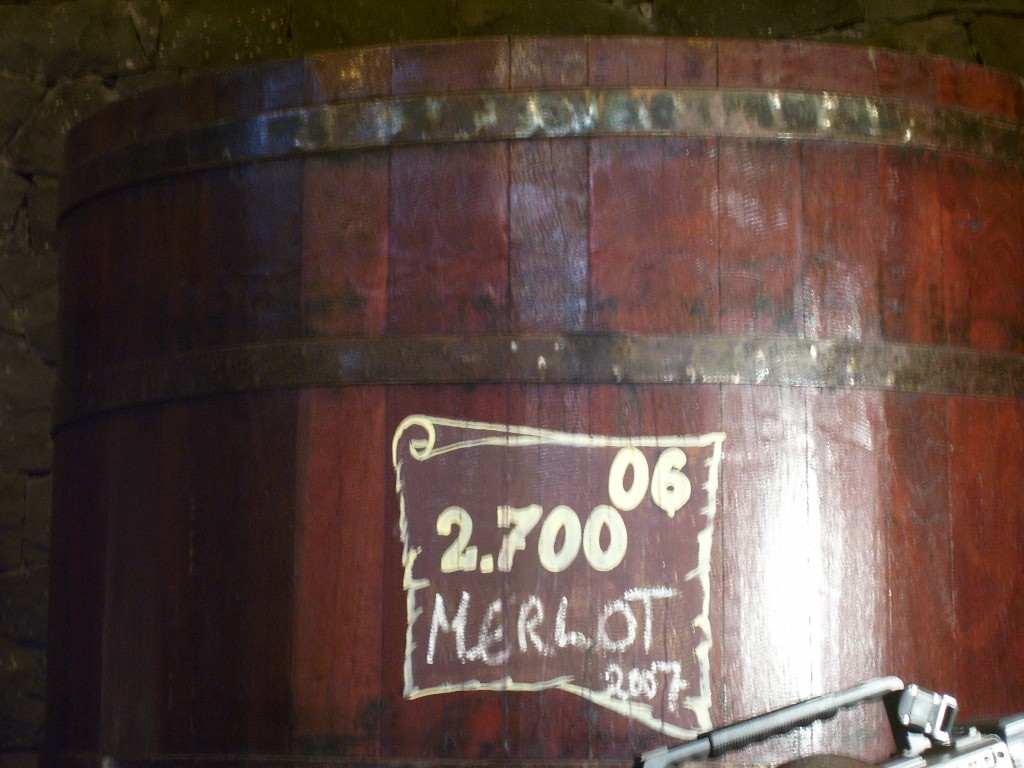
Here in Bento, the welcome has been one of the warmest. The arrival of an Italian person represents to people around here the opportunity to tell their story as migrants and progenies and to demonstrate their preserved love for their faraway Country. All of them care for getting me acquainted with their origins and for telling me the history of their grandparents or their emigrated parents from Italy. Bento GonÁalves is a city of 80 000 inhabitants, situated on the East part of the region Rio Grande do Sul in the south of Brazil. Anything has to do with the landscapes we are used to see of Brazil; here we are in Serra Gaúcha, hill landscape, it seems like a country around my place which is called Valdobbiadene. The likeness with this placed is also marked by another detail: Bento Gonçalves is the capital of wine.
Just out of the center, a stretch of vineyards of the most common qualities of around my place. Besides, everyone here speaks Veneto dialect. Bento is a city built from 1875 by the first colonies of Veneto immigrants who, when they arrived (not finding any living soul), continued to speak their dialect and so the idiom has been handed down and kept in the course of time. I did 15 thousands km to come back home!
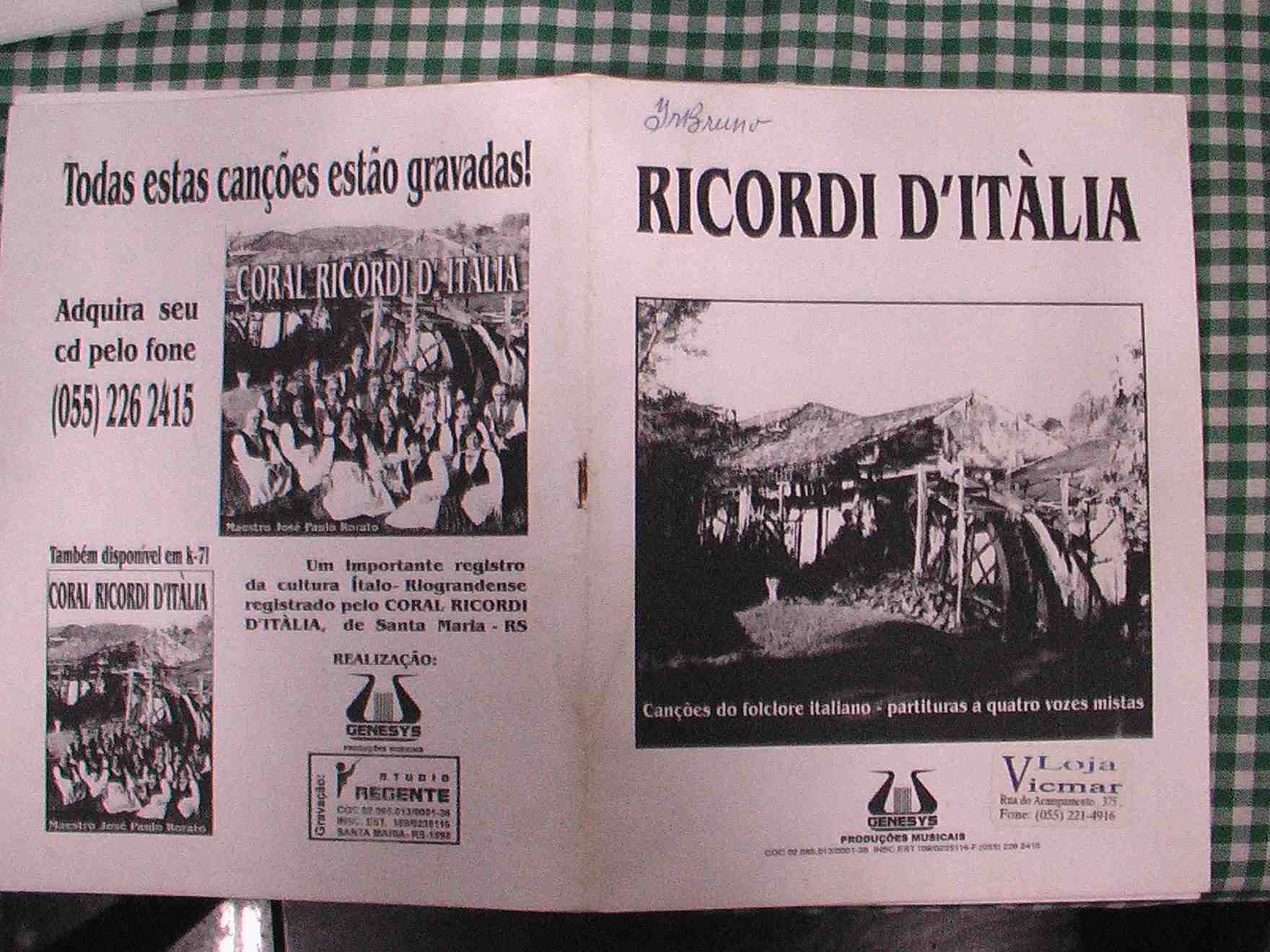
The map of the city speaks out, here we are in Italy: la Via del vino, Posada Casa Mia, Hotel Imigrantes, Primavera, pasta, pizza... on Radio Viva and on Radio Bento one listen only to Old Italian music. They are waiting for me for an interview. I say that I donít speak Portuguese. No harm done! Here they speak dialect, a strict and archaic dialect, with some very funny words like "cusita, catár, mistieri". So I take part, with some winemakers, to a program of wine and food, with lots of bottles of wine and glasses on the desk of the radio. The following days will be dedicated to parties in a Veneto-Italian style, characterized by a strictly live performed sound track, typically Italian. The most popular piece is thehymn of the migrants: Merica Merica Merica.
I met Elena of Coral Terra Nostra. She is a really turmoil of words. Her husband Nelson is the director of the chorus, they invite me for a Churrasco. On the wall of their house many Italian references are hanged: plates assigned to the chorus by Italian political personalities, the marriage act of the emigrated grandpa, emigrantsí letters, and maps of Italy. After lunch Elena and Nelson invite me to participate to an exhibition of the chorus in the "A Maria Fumaça", a train of 1908 with a steam locomotive which take a very suggestive touristic route. During the tour the various folkloristic Italian groups and the gaúchos perform. Then the tourists get off and in the train only the artist and I remain; so the Coral Terra Nostra performs for me singing Veneto songs which I haven't heard long since, others which I have never heard before..
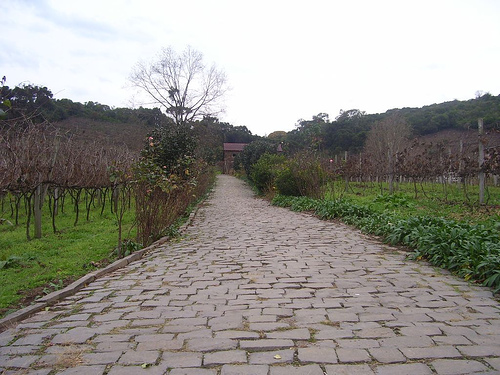
The director of the hotel "Vinocap" Tarciso Michelon invited me to see the surroundings of Bento Gonçalves one day to get a sense of how our first emigrants got organized and what kind of difficulties they had to deal with when they arrived, hopeful, in the Brazilian land. The "Caminhos de pedra" is today a touristic rural cultural project which has the aim of preserve the wine and food tradition, the architecture and the memory of our first emigrants.
Nestor José Foresti came with me in this path. The more we carry on the path we have the opportunity to admire and visit the houses built with the rocks that the emigrants had to remove from the ground to cultivate it. They are very pretty and totally handmade with an unbelievable ability. Or there are houses built with precious wood planks of a particular pine which grows around here. Nestor tells me that emigrants were attracted here with the illusion of meeting huge fertile fields and richness, when on their arrival they crashed with the plain truth: there was the field, but before cultivating it, it was necessary to deforest it. Having a walk to join the falls of Bento we had to fight our way among thick and matted vegetation. This is the scenery which was presented in front of the eyes of who left a whole life to arrive thus far. Besides all this green there was nothing else; immigrants were abandoned to their selves, without heath care, without education, without a home. They had to do everything by their selves, trying to survive to the dangers of this forest. Observing the present landscape I realize how much work has been made and of what is able the hand of man. Nelson tells me other worrying anecdotes which have to do with the "market of emigration".
IN Bento Gonçalves Anna Tedesco Varian lives in great shape, age class 1910, she arrived here in Brazil, Porto Alegre, in 1927 straight from Solagna di Bassano del Grappa: It seems she is the only native Italian in Bento. Anna, in the morning, works in a nursing home for old people, in the afternoon in a material raising center for poor people of which she is the president. She lives on her own and she drives a beautiful orange Beetle of 1973. Anna tells me her story as emigrant: the fascism in Italy, the postwar and the Italian poverty, the choice, the long marine travel on the ship "Giulio Cesare" with other 2400 emigrants, the arrival at night in Rio de Janeiro and the first emotions and doubt: «with all these light there has to be some white people too». the transport to Porto Alegre last 7 days in a hold of a ship among the bananas, then the choice in 1937 to move to Bento Goçalves «It has been a great thrill arriving to Bento and meet in my imagination there where I lived in Solagna». Anna speaks Italian, her mother spoke dialect but she has always wanted to speak the "grammatical Italian". She performs for me an Italian song, learnt at school for the arrangement of a musical play organized by her teacher. The book in which are written the words of the song is named "La Scuola". This is the only Italian song she remembers. She was 12. (MP3 below)
Thanks to: my friend Padre Isidoro, the parish center of Santo Antonio, the director of the hotel VinoCap Tarcisio Michelon, Radio Viva, Radio Bento and Radio Conegliano, Nestor José Foresti, Coral Terra Nostra especially to Elena and Nelson Franceschini, Agenzia Giordani Turismo LTDA, Beto Valduga who sings a beautiful old Italian song "Abassa la tua radio", to Remy Valduga, who gave me his book "Sonho de um imigrante". TO THE WHOLE BENTO GONÇALVES. (20070617)
Marcelo Martinez Garcia, who people call “Marcelo king of the bolero” is a musician who in the fifties used to spend his days with his friend Hemingway, playing boleros and enjoying the wonderful landscape in the Cojimar quarter, a breathtakingly beautiful place, situated in Havana del Este, a little bit out of the way with respect to Havana Vieja. Nowadays Marcelino plays in front of the monument erected to Hemingway with his Trio Hemingway (Neraida, Reinaldo, Marcelino) in the hope of receiving some money from tourists, fascinated by the cuban son and Marcelino's stories. VERSIÓN EN ESPAÑOL- VERSIONE IN ITALIANO
THE STORY: “One day a girl wrote a message ON my blog: when I left Cuba I had more questions than I had when I arrived.. at that moment the message on the banner of my blog was: I'm trying to be in tune with Cuba.
Cuba is a different country. Different from every country I've ever visited.; it has lots of facets, contradictions, paradoxes, absurdities.. however it keeps its equilibrium. Any tourist who would like to go to Cuba to waste his money and to get rid of his frustrations with nice prostitutes and Cubalibre, will find here his banal heaven. On the other hand those who would like to know the soul of Cuba, its population and its reason for being, will have to rack their brains and work hard, trying to find something truly strong and different”.
WARNING:this is the beginning of a story that I'm writing about my Cuban experiences. I'm not going to continue because it would be too long, I just want to warn the spectator: not everything is as it seems to be! Probably those who have never been to Cuba or those who have lived there with the shallowness that I described before, will only understand from this video the cuban stereotype: in the collective consciousness Cuba seems like a Carribean island, joyful and carefree, managed by political heroes that are fighting against the “global system”. However this isn't the truth: life is very hard and poor here and the cuban population has to invent ways to survive, frequently stooping to compromises.
CONCLUSION: Neraide has resigned from her job for health problems, now she is retired...without a pension, Reinaldo has difficulties with growing and supporting his wonderful daughter, Marcelino is a Cuban who has been spending is whole life as a busker; he lives in a house very small that smells of pee because the pipages doesn't work properly. The shining of his eyes it's a sure sign that you have to be pleased with what you have..and that music is a strong treatment.
23-01-11 Iztapalapa, Mexico City. It is my birthday and this year I celebrate it in a very special way. To begin, here in Mexico, when it is somebody's birthday he/she has not to pay for anyone drink, other people pay you the party and this seems to me a beautiful tradition; it is tradition to engage a Mariachi group to sing a suitable song for this moment to the birthday-boy. That is not the very common and very banal "Happy Birthday"; it is a Mexican tradition, kept by other Countries of Latin America too, to sing "Las MaÒanitas", a very sweet and slow piece (lyrics and music in the video). The best known version is the one sung by Pedro Infante, the best known Mariachi in Messico, in the film "Nosotros los pobres"
In the Mexican culture it is very important to celebrate women's adulthood for their 15 years (that is why the singer is ironic about this number); this social initiation ritual grounds its roots in the pre-Hispanic societies and symbolizes the entry of the birthday-girl in the adulthood.
The Mariachy are not easy to be "turned off" and their energy is contagious; so from the birthday piece we move to the dance piece 'till we end with the melancholy "Cancion Mixteca" which they dedicate me because I am Italian and far away from my Country.. but the words don't reflect my present mood.








 (p)Link
 Commenti
 Storico
 Stampa



 I’ve known that many ethno-musicologistsand and anthropologists have been studying for many years in loco the traditions of those people, but they have never had the permission to take part in their religious rituals. So I count myself lucky to have attended one of their musical demonstrations organized only for me.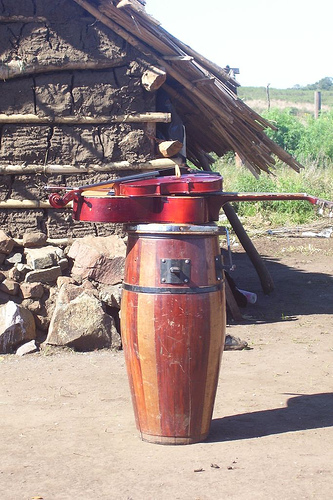
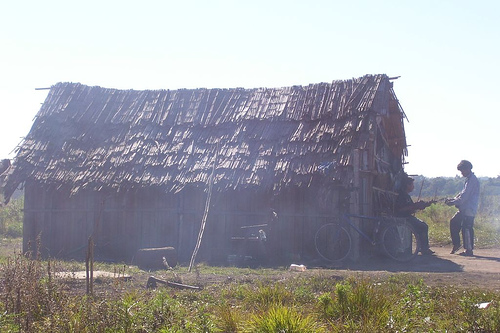
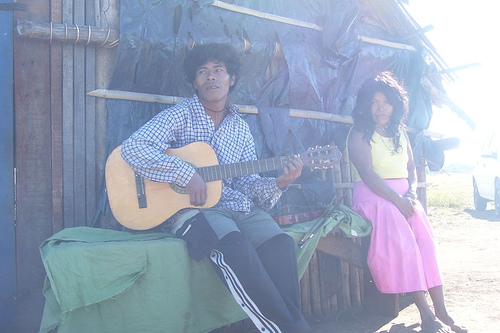
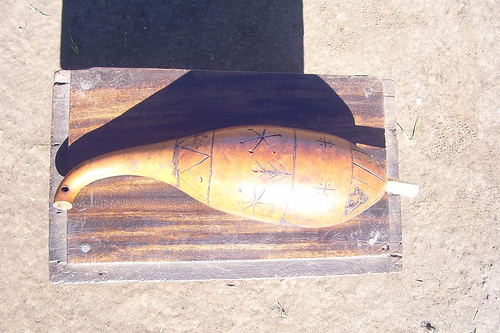
 beneficing houses, families and domestic animals, singing about Sant’ Antonio fighting against the devil.
 the human relationships, because it is based on a religious-playful aspect, on the exchange, on the joke, on the chat, on the demonstrations of careness and affection.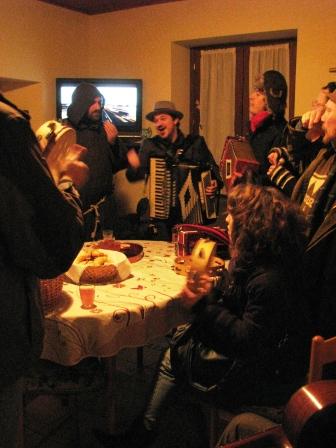
 This is, in fact, the site where in September and October people celebrate an ancient and
 She says that what we will see aren’t the songs and dances of the mysterious ritual, but only a demonstration of how they are committed to preserve and let know their own culture. The group join up; it’s composed by six men and three women and a series of children who are looking at us a little bit scared. We all get on a wrecked bus with our instruments and costumes in order to reach the borders of the forbidden territory. During the journey on dirt and full of holes roads, Elaine and I – in the group we seem two white spots – try to have a dialog with our companions who unexpectedly reveal themselves very nice and friendly. Children look at me furtively and when I cross their eyes they turn their head and – blushed – they guffaw. The sense of “extraneousness” that I perceive is so deep.
 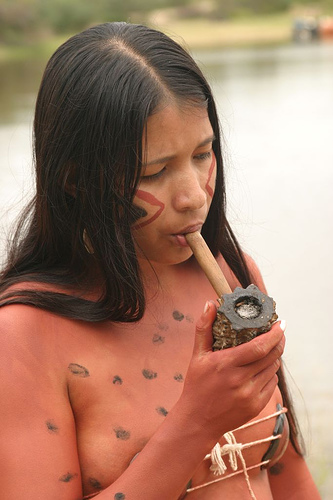 After the performance I walk for a while with the quesique who shows me the different plants of the aldeia and their therapeutic functions. He says he can treat every indisposition without using chemical or pharmaceutical cures. The dancers go again into the lake to clean their bodies from the dye and then we come back all together to the aldeia. Many natives go away to work, I remain there with Eleine, Vera and some inhabitants in a small house with a table and a sofa. I – stubborn – continue to make more specific questions about music and culture, but I continue to take out few information. I ask to explain me at least what’s about the song I’ve recorded.
  I arrive to
  represents to people around here the opportunity to tell their story as migrants and progenies and to demonstrate their preserved love for their faraway Country. All of them care for getting me acquainted with their origins and for telling me the history of their grandparents or their emigrated parents from Italy. Bento GonÁalves is a city of 80 000 inhabitants, situated on the East part of the region
  The map of the city speaks out, here we are in Italy:
  I met Elena of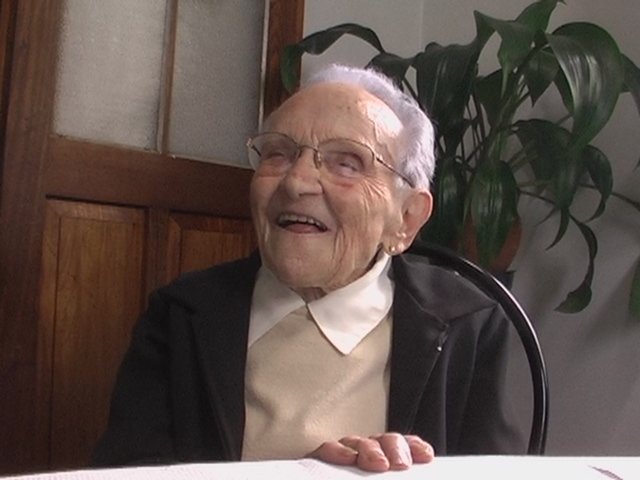





 Feed RSS 0.91
 Feed Atom 0.3